
Wall Yoga for Beginners: 7 Restorative Poses to Release Tight Hips & Stiff Backs
November 27, 2026 • 7 min read • By Manoj Kumar
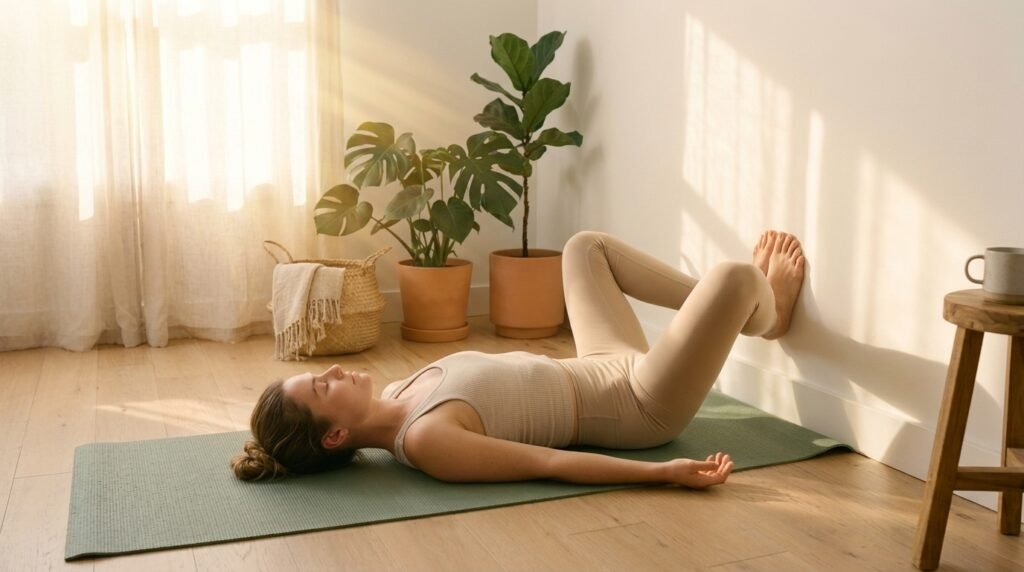
If you have spent any time browsing wellness feeds recently, you have likely noticed millions of practitioners abandoning complicated mat acrobatics in favor of a surprisingly humble prop: a clean bedroom wall. Wall yoga for beginners has taken the mindful movement world by storm, and for good reason. By transferring your body weight to a vertical boundary, you eliminate balance anxiety, decompress compressed lumbar vertebrae, and allow chronically tight hips to release without muscular strain.
Why the Wall Works Like Magic: When you stretch in free space, stabilizing muscles work overtime to keep you from falling over, creating subtle muscular tension. Against a solid wall, gravity does all the work. Your nervous system feels secure, muscle spindles soften, and stubborn fascial restrictions around your pelvis melt away.
The Biomechanics of Wall Yoga: Zero-Gravity Hip & Spine Relief
Modern desk life traps our bodies in prolonged hip flexion. Hip flexors shorten, the piriformis tightens over the sciatic nerve, and the pelvis tilts, dragging the lower back into persistent discomfort. (If you frequently struggle with morning stiffness, pairing wall yoga with our foundational guide to yoga for back pain relief will give you 24-hour comfort).
When you practice with your legs elevated against a wall, three therapeutic shifts occur immediately:
- Passive Pelvic Neutrality: The floor stabilizes your sacrum and spine, preventing awkward compensations.
- Gravity-Assisted Venous Return: Fluid stagnant in your feet and ankles circulates effortlessly toward your heart and lymph nodes.
- Vagal Activation: Combining supported postures with nasal breathing signals your parasympathetic system to downshift stress, similar to our calming sequence for bedtime yoga for deep sleep.
7 Restorative Wall Yoga Poses Anyone Can Do
Place your yoga mat perpendicular to an empty wall. You can place a folded towel or thin blanket under your hips if your lower back prefers extra cushioning (find the right thickness in our guide to the best yoga mats for beginners). Move gently through these seven poses in order.
1. Wall Butterfly (Baddha Konasana Against the Wall)
Target Area: Inner groins, adductors, pelvic floor release, lower back easing.
- How to do it: Lie on your back with your hips close to the wall (roughly 3 to 6 inches away). Bend your knees, press the soles of your feet together, and slide your feet downward along the wall so your knees naturally drop open in a diamond shape.
- The practice: Rest your hands gently on your inner thighs or belly. Do not force your knees toward the wall; simply let the weight of your legs create a natural, effortless stretch across your inner groins.
- Duration: 2 to 3 minutes. Focus on slow, rhythmic belly breaths.
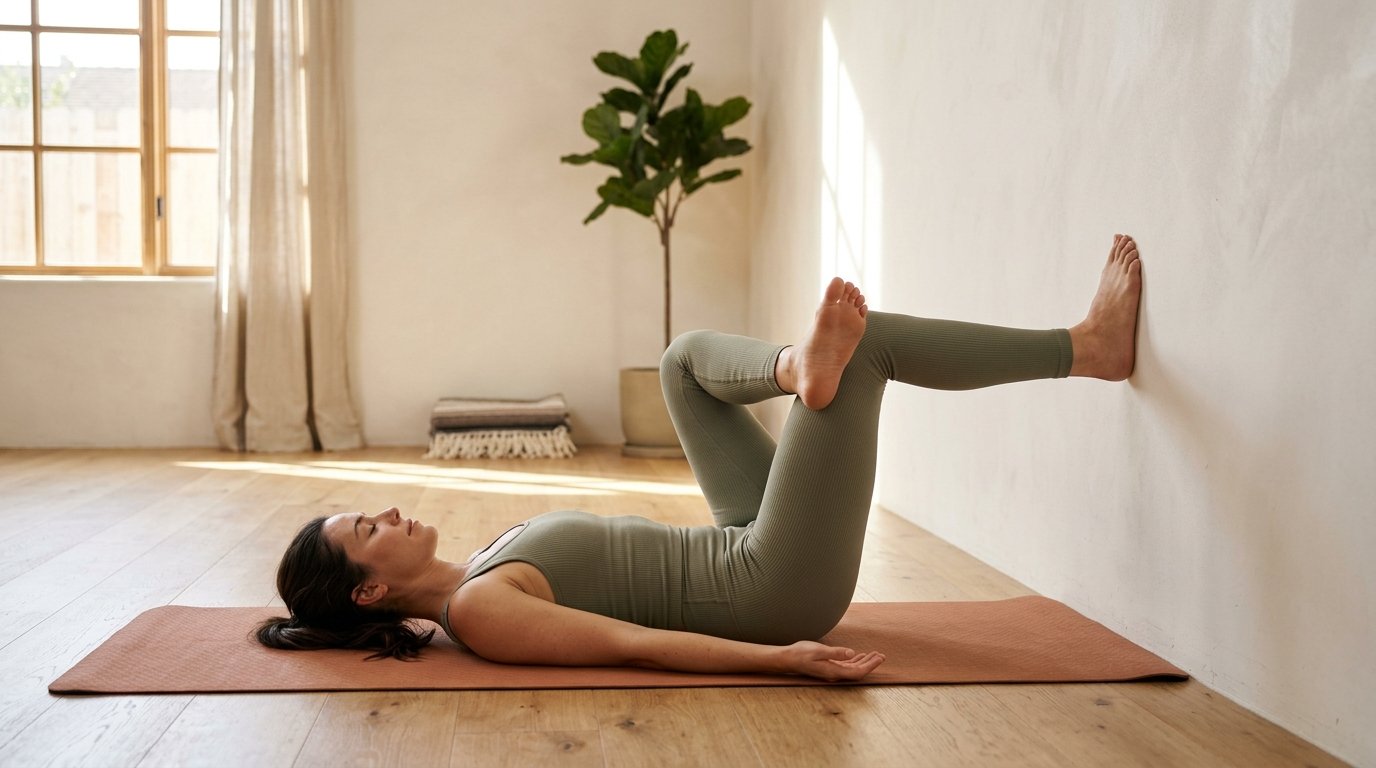
Wall Figure-Four (Wall Pigeon): Pressing the supporting foot flat against the wall stabilizes the knee at 90 degrees, delivering deep outer-hip decompression without torquing your knee joint.
2. Wall Figure-Four / Wall Pigeon (Sucirandhrasana at the Wall)
Target Area: Deep piriformis, outer gluteus medius, sciatic nerve pathway.
- How to do it: From your back, place your right foot flat against the wall with your right knee bent at approximately 90 degrees. Cross your left ankle over your right thigh just above the knee, creating a clear figure-four shape.
- The adjustment: Keep your left foot flexed to protect your knee. If the stretch feels too intense, simply scoot your hips a few inches farther back from the wall. If you want a deeper stretch, slide your right foot slightly lower down the wall.
- Duration: 2 minutes per side. Unlike traditional pigeon pose which places heavy weight on the front knee, the wall variation offers 100% control with zero joint compression.
3. Wall Wide-Leg Straddle (Upavistha Konasana Against the Wall)
Target Area: Hamstrings, inner thigh adductors, pelvic circulation.
- How to do it: Extend both legs straight up against the wall. Slowly allow your legs to slide open into a wide “V” shape until you feel a gentle, pleasant stretch along your inner thighs.
- Pro Tip: Gravity is doing the work here. If your inner thighs feel like they are shaking, place yoga blocks or pillows under your outer thighs to catch them (read our guide to yoga accessories worth buying).
- Duration: 2 to 3 minutes.
4. Supported Wall Bridge (Setu Bandha Sarvangasana at the Wall)
Target Area: Gentle glute activation, thoracic spine opening, hip flexor lengthening.
- How to do it: Place both feet flat against the wall, hip-width apart, with knees bent at 90 degrees. Press your feet into the wall and gently lift your hips off the floor, rolling your spine up into a soft bridge.
- Modification: Slide a yoga block under your sacrum for passive support, or simply hold the gentle lift for 5 to 6 breaths before rolling down one vertebra at a time.
- Duration: 1.5 to 2 minutes.
5. Wall Supine Spinal Twist
Target Area: Lumbar spine rotational ease, latissimus dorsi, oblique decompression.
- How to do it: With knees bent and feet resting on the wall, open your arms wide in a “T” position. Shift your hips slightly to the left, then gently drop both knees over to the right until the outer right thigh rests on the floor or a pillow.
- The practice: Turn your gaze softly toward the left fingertips. Take 5 slow, unhurried breaths into your left side ribs, feeling your torso expand and unwind.
- Duration: 1.5 to 2 minutes per side.
6. Classic Legs-Up-The-Wall (Viparita Karani)
Target Area: Full nervous system reset, venous drainage, quiet mental restoration.
- How to do it: Bring your legs together and extend them straight up the wall. Rest your arms comfortably beside you, palms facing up. Close your eyes and soften your jaw, tongue, and eyelids.
- The practice: This timeless inversion lowers heart rate, eases swelling in calves and ankles, and acts as an immediate antidote to workday mental fatigue.
- Duration: 3 to 5 minutes. Combine this with extended exhales as detailed in our guide to 10-minute morning breathing exercises.
7. Standing Wall Puppy Stretch (Uttana Shishosana at the Wall)
Target Area: Upper back hunching, shoulder mobility, chest opening.
- How to do it: Stand up facing the wall, roughly arm’s length away. Place your palms flat on the wall at shoulder height. Step your feet back and hinge at your hips, lowering your chest toward the floor until your torso is parallel to the ground in a 90-degree angle.
- The practice: Keep your ears in line with your biceps and breathe deeply into your upper back. This instantly reverses the rounded, slouched posture caused by typing on laptops or looking down at phones.
- Duration: 1 to 2 minutes.
Stay Accountable With Your Daily Restorative Practice
Track your gentle wall stretches, morning routines, and evening wind-down rituals in our beautifully designed 30-day consistency workbook.
Curated Gear for a Slip-Free Wall Practice
Because wall yoga relies on pressing your feet and hips against surfaces, having reliable traction beneath you prevents your mat from bunching or sliding:
WiseLife Classic 6mm High-Traction Mat
Provides dual-sided grip so your mat stays anchored against the baseboard while protecting your spine and sacrum on hard floors.
Strauss High-Density Natural Cork Yoga Block (Pair)
Perfect for supporting outer thighs during Wall Straddle or elevating your pelvis in supported wall bridges without wobbling.
Common Mistakes to Avoid
- Jamming Your Hips Right Against the Baseboard: If your hamstrings or lower back are stiff, jamming your tailbone directly against the wall causes your pelvis to tuck and your lower back to round uncomfortably. Keep your hips 3 to 6 inches away from the wall so your lower back rests in its natural, neutral curve.
- Holding Your Breath During Deep Stretches: In postures like Wall Pigeon, intense sensation can tempt you to hold your breath. Keep your jaw relaxed and let every exhale soften the outer hip.
- Abrupt Exits: Do not jump up quickly after spending several minutes in inverted wall poses. Bend your knees, roll slowly onto your side, rest in a fetal position for 30 seconds, and gently press up to seated.
Whether you practice for 7 minutes after work to wash away desk fatigue or spend 15 minutes before bed to prep for deep sleep, wall yoga proves that the simplest tools often yield the most profound somatic relief.
Loved this?
Join Slow Mail — Tuesday journals + Sunday rituals.