
Yoga for Back Pain: 7 Gentle Morning Stretches for Daily Relief at Home
November 12, 2026 • 8 min read • By Manoj Kumar
Waking up with a dull ache in your lower back or feeling stiff after hours at a desk can make even simple morning movements feel guarded. When your lumbar spine and hips feel tight, aggressive stretching or complex acrobatic poses often do more harm than good. Instead, a targeted sequence of gentle restorative yoga for back pain works with your body’s natural biomechanics to decompress compressed vertebrae, lengthen taut hamstrings, and calm reactive back muscles.
Core Rule for Back Relief: Never force flexibility or push into sharp pinches. In restorative yoga, progress comes from slow, supported unwinding where your muscles feel safe enough to release protective spasms. Always practice on a properly cushioned mat (learn more in our guide to the best yoga mats for beginners).
Why Does Lower Back Stiffness Build Up Overnight?
During sleep, spinal discs rehydrate and expand, while surrounding fascial tissues cool and contract. If you sleep in a curled posture or carry daytime tension in your hip flexors from long sitting sessions, your pelvis remains tilted forward or backward as you wake up. This mechanical tug-of-war places continuous strain across the lumbar spine and sacroiliac (SI) joints.
Practicing a calm 12 to 15-minute sequence first thing in the morning gently circulates synovial fluid through your facet joints, coaxes tight gluteal muscles to relax, and resets your nervous system before daytime stressors accumulate. If you are brand new to yoga, reviewing our foundational yoga for beginners at home guide will help you align your breath with each motion.
7 Gentle Yoga Stretches for Daily Back Pain Relief
Set a gentle timer, keep a folded blanket or yoga block nearby, and move through these seven poses in order. Breathe entirely through your nose with slow, steady inhales and exhales.
1. Constructive Rest Pose with Diaphragmatic Breathing
Target Area: Psoas release, lumbar settling, autonomic nervous system down-regulation.
- How to do it: Lie flat on your back on your mat. Bend your knees, place your feet flat on the floor wider than hip-width apart, and let your knees gently rest together in an inward tent. Rest one hand on your chest and one on your belly.
- The practice: Inhale for 4 counts into your lower abdomen, allowing your lower back to soften completely into the floor without forcing it flat. Exhale slowly for 6 counts.
- Duration: 2 to 3 minutes (10 to 12 deep breath cycles). Synchronizing diaphragmatic breath here signals muscle spindles along the spine that it is safe to let go of guarding tension, just as detailed in our guide to morning breathing exercises for calm and focus.
2. Slow Cat-Cow Spine Warmup (Marjaryasana-Bitilasana)
Target Area: Thoracic and lumbar segmental mobility, spinal fluid circulation.
- How to do it: Transition to hands and knees. Place your wrists under shoulders and knees directly beneath hips. Spread your fingers wide to distribute weight evenly through your palms.
- The movement: On an inhale (Cow Pose), gently drop your belly toward the mat, roll your shoulders back, and gaze forward without hyperextending your neck. On an exhale (Cat Pose), press firmly through your hands, tuck your chin toward your chest, and round your entire spine upward like a stretching cat.
- Duration: 8 to 10 slow, fluid breath cycles. Keep the movement small and pain-free; focus on rolling through each vertebra one at a time.
3. Gentle Supine Knee-to-Chest (Apanasana)
Target Area: Lower back decompression, sacral flattening, gentle hamstring stretch.
- How to do it: Return to lying on your back. Draw your right knee toward your ribcage, interlacing your fingers around your shin or the back of your thigh. Keep your left leg either extended flat or bent with the foot on the floor if your lower back feels sensitive.
- The practice: Hug the knee gently inward on each exhale while keeping your head, neck, and shoulders relaxed on the mat. After 5 to 7 breaths, switch sides, then hug both knees together and make gentle micro-circles across your sacrum.
- Duration: 1 minute per side.
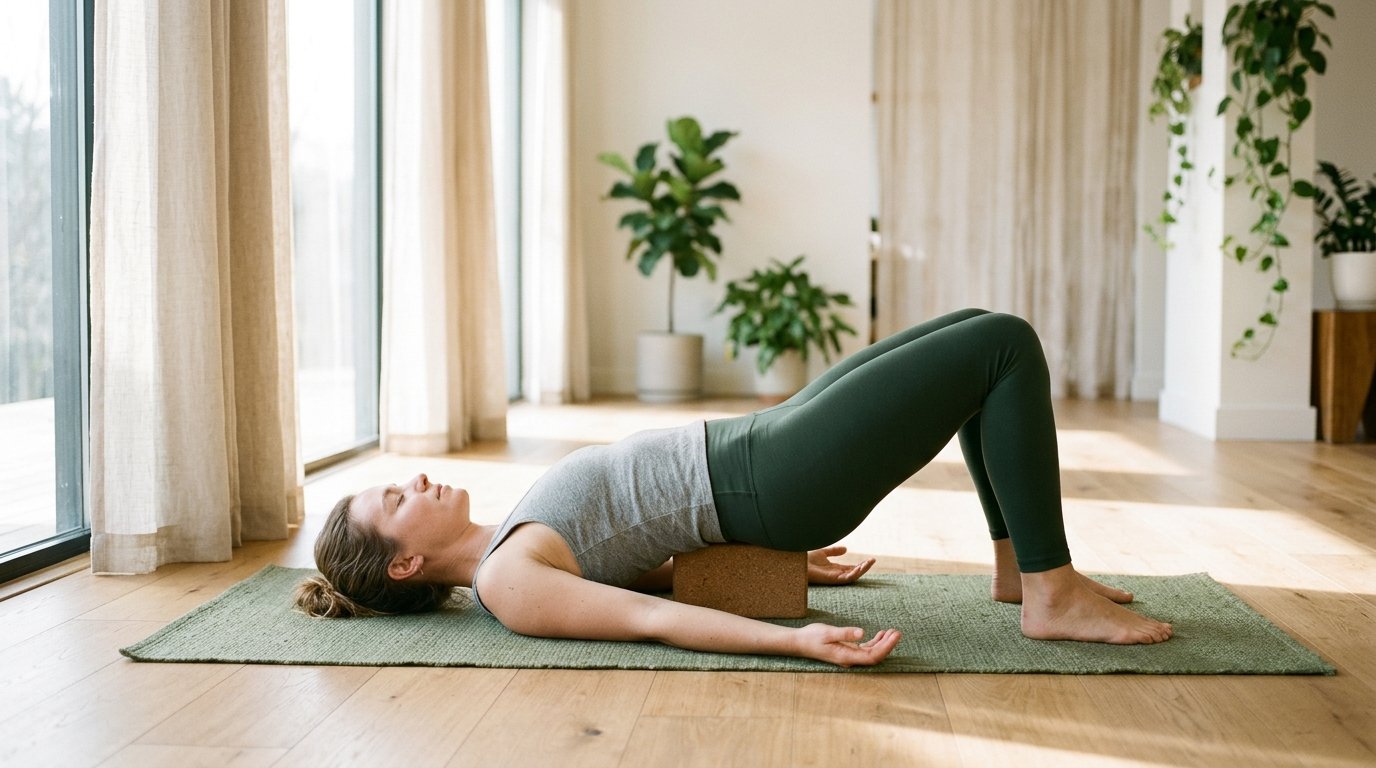
A high-density cork yoga block placed horizontally beneath the sacrum elevates the pelvis passively, providing natural lumbar decompression without muscular effort.
4. Supported Bridge Pose with a Yoga Block (Setu Bandha Sarvangasana)
Target Area: Passive lumbar traction, hip flexor lengthening, chest opening.
- How to do it: Lie on your back with knees bent and feet flat on the floor, hip-width apart and parallel. Press gently through your heels to lift your hips just high enough to slide a yoga block (at its lowest or medium height) directly under your sacrum—the broad, flat bone at the base of your spine.
- The practice: Lower your weight completely onto the block. Rest your arms along your sides, palms facing upward. Allow gravity to open the front of your hips while your lower back rests completely unsupported by muscular effort.
- Duration: 2 to 3 minutes. (Using a solid cork block prevents wobbling; see our recommendations in yoga accessories worth buying).
5. Reclined Figure-Four Stretch (Supta Kapotasana)
Target Area: Piriformis muscle, outer glutes, sciatic nerve path easing.
- How to do it: From your back, cross your right ankle over your left knee, creating a “figure 4” shape. Flex your right foot firmly to protect your knee joint.
- The movement: Lift your left foot off the floor and thread your hands through to clasp behind the left hamstring. Gently draw the left thigh toward your chest while encouraging the right knee to stay open naturally.
- Modification: If reaching your hamstring rounds your shoulders off the mat, wrap a yoga strap around your thigh or simply rest your left foot on a wall.
- Duration: 1.5 to 2 minutes per side. Releasing chronic tightness in the deep hip rotators directly reduces lateral pull on the lower spine.
6. Restorative Supine Spinal Twist with Knee Support
Target Area: Gentle rotational mobility, latissimus dorsi, oblique decompression.
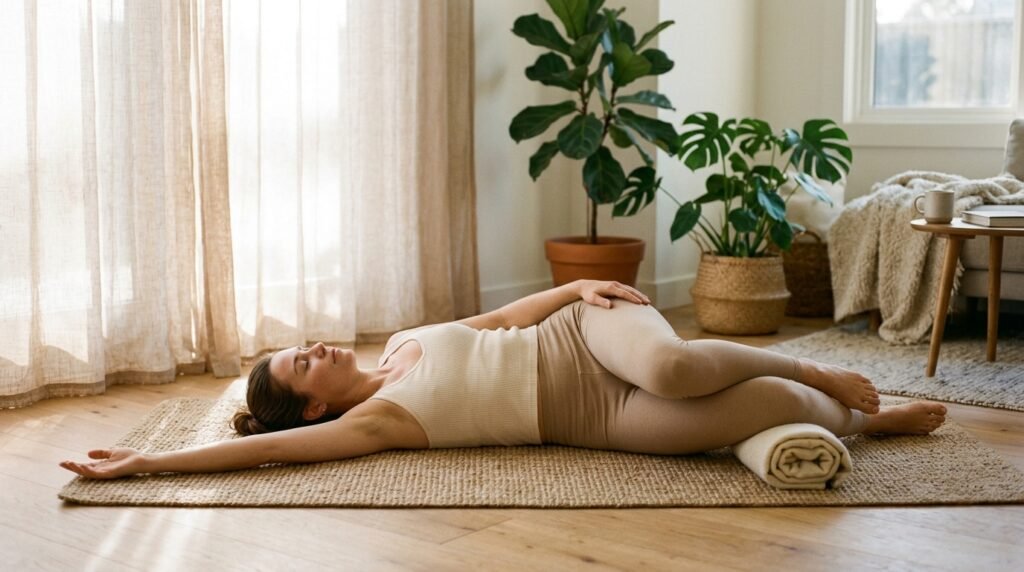
- How to do it: Lie flat and bring both knees toward your chest. Open your arms wide in a “T” or gentle cactus shape. Shift your hips two inches to the right, then let both knees melt over to the left side.
- Pro Tip: Place a folded yoga blanket or bolster beneath or between your knees. When your knees rest on supportive cushioning rather than hanging in midair, your lower back muscles do not contract to stabilize the twist.
- Duration: 2 minutes per side. Close your eyes and direct your breath into the right side ribs and lower back.
7. Wide-Knee Supported Child’s Pose (Balasana)
Target Area: Full posterior chain release, inner thigh relaxation, mental grounding.
- How to do it: Roll to hands and knees. Bring your big toes together and widen your knees as wide as your yoga mat. Sink your hips back toward your heels and walk your fingertips forward, resting your forehead on your mat or on a folded blanket.
- The practice: Allow your chest to sink toward the floor between your thighs. On each inhale, feel your ribcage expand into your lower back; on each exhale, let your hips sink a fraction of an inch closer to your heels.
- Duration: 2 to 3 minutes. This final resting pose integrates your practice and seals the morning session with grounded calm.
Build a Consistent Daily Yoga Practice Without Strain
Track your gentle morning movement, log your posture reflections, and follow daily habit cues designed for healthy joints and a relaxed lower back.
Essential Gear for Safe Back Support at Home
Practicing yoga for back relief requires stability and cushioning so your joints feel protected. We recommend investing in two foundational tools that make every restorative stretch safer and more comfortable:
WiseLife Classic 6mm High-Density Mat
Provides dual-sided non-slip grip and firm 6mm joint cushioning so your knees and lumbar spine are fully protected on hard tile or wooden floors.
Strauss High-Density Natural Cork Yoga Block
Firm, non-slip cork block that provides steady support under your sacrum for passive bridge poses and assists tight hamstrings during seated folds.
Common Mistakes to Avoid When Stretching a Stiff Back
- Aggressive Forward Bending with Straight Legs: Folding forward while rounding a stiff lower back with locked knees places severe shear stress on the lumbar discs. Always bend your knees generously when folding.
- Holding Your Breath: Shallow chest breathing or holding your breath activates the sympathetic “fight-or-flight” response, keeping muscles rigid. If you cannot breathe smoothly through your nose, back out of the pose slightly.
- Twisting From the Lower Back Alone: Lumbar vertebrae have very limited natural rotational mobility (roughly 5 degrees). Let the twist originate from your thoracic spine and ribcage rather than yanking your hips around.
- Rushing Through Transitions: Moving abruptly between poses can cause muscle spasms. Take 3 to 5 seconds to transition gently between each movement.
When to Stop and Consult a Doctor
While gentle yoga helps manage everyday muscle tightness and posture-related stiffness, it is not a cure for acute spinal injuries. Stop immediately and speak with a qualified physician or physical therapist if you experience any of the following:
- Sharp, shooting pain radiating down your leg, thigh, or foot (sciatica symptoms).
- Numbness, tingling, or weakness in your legs or toes.
- Pain resulting directly from a recent fall or physical trauma.
- Severe pain accompanied by unexplained fever or bowel/bladder changes.
For daily posture stiffness and morning tight hips, practicing these 7 gentle poses consistently—paired with patience and slow nasal breathing—will help you move with greater ease, confidence, and comfort every morning.
Loved this?
Join Slow Mail — Tuesday journals + Sunday rituals.