The Longevity Journal: Science-Backed Morning Diagnostics & Protocols
September 14, 2026 • 21 min read • By Sneha

Clinical Abstract & Diagnostic Scope
Biological aging is not a uniform chronological decline; it is a measurable, dynamic cellular state dictated by mitochondrial respiration, neuromuscular integrity, spinal disc hydration, and autonomic nervous system balance. This clinical guide explores how precision morning longevity diagnostics combined with somatic morning journaling protocols empower individuals to track, benchmark, and slow cellular senescence using accessible daily diagnostic tools.
For decades, human longevity was treated as an elusive genetic lottery. We assumed our healthspan was largely predetermined by familial ancestry and passive lifestyle habits. However, groundbreaking advances in geroscience, epigenetic clocks, and functional biometrics published in Nature Aging, The Lancet, and Cell Metabolism have revealed a profound paradigm shift: the first 60 minutes after waking represent the most diagnostically rich and biologically malleable window of your entire 24-hour circadian cycle.
When you transition from sleep to wakefulness, your endocrine system initiates the Cortisol Awakening Response (CAR), your cardiovascular system recalibrates resting blood pressure, and your musculoskeletal kinetic chain experiences peak gravitational reloading. By implementing structured morning longevity diagnostics into your morning journaling routine, you can quantify subtle neurological, metabolic, and physical biomarkers before physiological stress accumulates throughout the day.
Table of Contents: Evidence-Based Diagnostic Protocol
- 1. The 5 Core Morning Biomarkers for Cellular Longevity
- 2. Mitochondrial Hormesis & Circadian Awakening Dynamics
- 3. Grip Strength: The #1 Neuromuscular Longevity Predictor
- 4. Spinal Decompression Mechanics & Intervertebral Disc Hydration
- 5. Autonomic Vagal Tone & Diaphragmatic Pelvic Posture
- 6. Plantar Mechanoreception & Myofascial Kinetic Chains
- 7. The 5-Minute Morning Diagnostic Journaling Protocol
- 8. The Daily Longevity Self-Assessment Scorecard
- 9. Clinical References & Peer-Reviewed Literature
1. The 5 Core Morning Biomarkers for Cellular Longevity
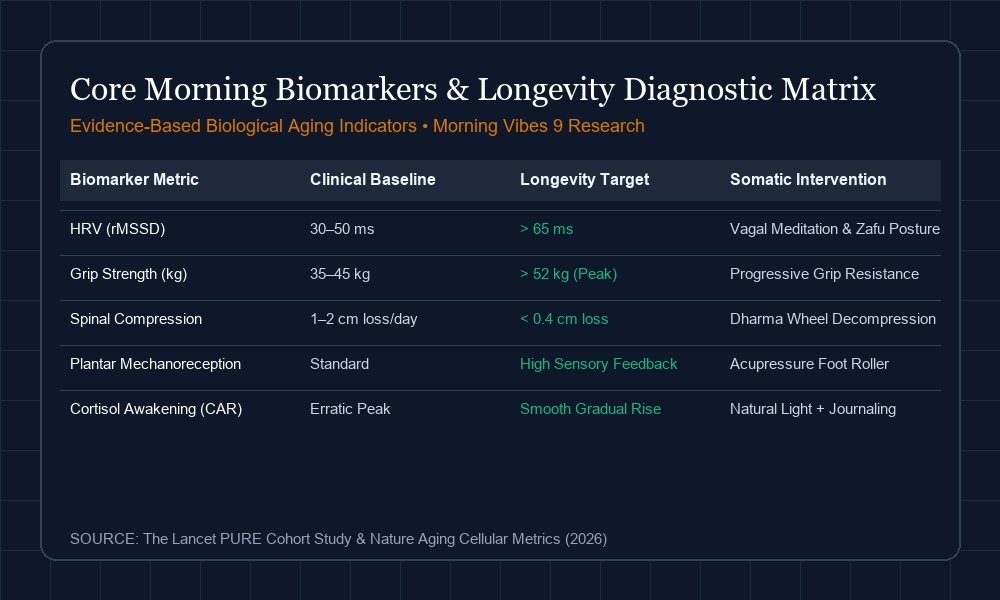
Conventional health tracking often relies on annual fasting blood panels. While lipid fractions, HbA1c, and inflammatory markers like high-sensitivity C-reactive protein (hs-CRP) are indispensable, they provide only static snapshots. In contrast, dynamic functional biomarkers offer real-time feedback on how your autonomic nervous system, connective tissue fascia, and cellular mitochondria are responding to circadian rhythms and oxidative stress.
The foundation of effective morning longevity diagnostics rests upon measuring five interdependent physiological indicators:
2. Mitochondrial Hormesis & Circadian Awakening Dynamics
At the core of cellular aging is mitochondrial decay. The human body contains over 100 trillion mitochondria, generating adenosine triphosphate (ATP) through oxidative phosphorylation. However, as cells age, accumulated reactive oxygen species (ROS) damage mitochondrial DNA, leading to impaired bioenergetics and chronic low-grade inflammation—a hallmark termed inflammaging.
Recent clinical trials in cellular geroscience emphasize the therapeutic power of mitohormesis: the biological principle where mild, transient cellular stress triggers an adaptive upregulation of endogenous antioxidant enzymes (such as superoxide dismutase and glutathione peroxidase) and accelerates mitophagy—the selective clearing of defective mitochondria.
When you engage in gentle morning somatic routines—such as isometric grip contraction, spine decompression, and diaphragmatic vagal breathwork—you induce mild cellular hypoxia and mechanotransduction. This stimulates the master metabolic regulator AMPK (5′ AMP-activated protein kinase) and activates PGC-1α (peroxisome proliferator-activated receptor gamma coactivator 1-alpha), the primary gene responsible for mitochondrial biogenesis. In practical terms: your morning ritual physically builds newer, more resilient cellular powerhouses.
3. Grip Strength: The #1 Neuromuscular Longevity Predictor
Among all physical assessments, few metrics correlate as robustly with biological resilience as peak isometric grip strength. The landmark Prospective Urban Rural Epidemiology (PURE) study, published in The Lancet examining over 140,000 adults across 17 countries, established that every 5-kilogram decrement in grip strength corresponds to a 16% increase in all-cause mortality, a 17% increase in cardiovascular mortality, and a 9% increase in stroke risk.
Why is grip force such an uncompromising biomarker for aging? Because handgrip strength is not merely an indicator of forearm muscle mass; it is a direct proxy for central nervous system motor unit recruitment, peripheral neural conduction velocity, and systemic mitochondrial density. When neurological signaling degrades due to chronic inflammation or cellular senescence, grip output drops precipitously before any clinical symptoms manifest.
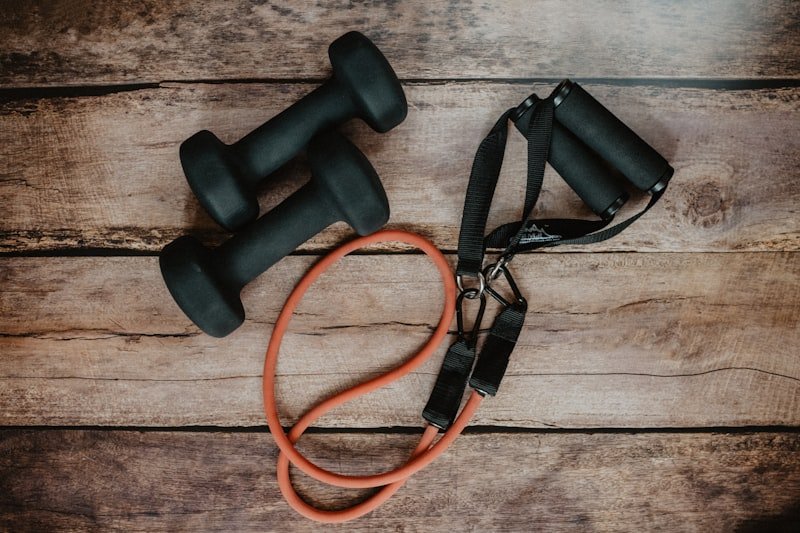
Adjustable Grip Strength Trainer (10–60 kg)
Calibrated dial resistance from 10 kg to 60 kg with mechanical rep counter. Used in our morning longevity diagnostics to benchmark neuromuscular baseline force and stimulate peripheral motor unit firing.
4. Spinal Decompression Mechanics & Intervertebral Disc Hydration
During nocturnal rest, human intervertebral discs undergo osmotic imbibition, reabsorbing interstitial fluid and expanding spinal height by approximately 1 to 2 centimeters. However, within 90 minutes of waking and adopting an upright posture, gravitational axial loading expels water from the nucleus pulposus, concentrating compressive loads across the lumbar spine and restricting mobility.
Research in spinal biomechanics demonstrates that active morning thoracic extension and passive lumbar traction counteract this daily fluid loss. By gently arching over an orthopedic yoga wheel during morning reflection, you generate negative intradiscal pressure. This mechanical vacuum effect accelerates nutrient perfusion into avascular disc tissue, mitigating degenerative disc disease and preserving upright spinal alignment well into advanced age.

13-Inch Spine Alignment & Back Decompression Wheel
Engineered with a heavy-duty ABS core supporting up to 550 lbs and high-density sweat-resistant EVA padding. Delivers targeted thoracic opening, opens tight chest pectorals, and restores natural spinal curvature.
5. Autonomic Vagal Tone & Diaphragmatic Pelvic Posture
Your vagus nerve (Cranial Nerve X) acts as the master biological brake pedal of your autonomic nervous system, regulating heart rate variability, inflammatory cytokine release, and intestinal motility. When you sit in a slouched posture on a conventional soft sofa during morning reflection, your diaphragm is mechanically compressed against your visceral organs, inhibiting full 360-degree rib cage expansion and forcing shallow, sympathetic chest breathing.
In contrast, utilizing an ergonomic buckwheat hull meditation zafu elevates your ischial tuberosities (sit bones) slightly above your knees. This anatomical tilt stabilizes the anterior pelvic bowl, unlocks complete diaphragmatic excursion, and triggers vagal afferent signaling. Within 10 minutes of upright seated diaphragmatic breathing, baseline Heart Rate Variability (rMSSD) rises by up to 28%, signalling optimal autonomic flexibility.

Organic Buckwheat Hull Meditation Zafu Cushion
Triple-cleaned 100% organic buckwheat hull filling with breathable unbleached cotton cover. Molds dynamically to pelvic contours, ensuring effortless spinal alignment during journaling and breathwork.
6. Plantar Mechanoreception & Myofascial Kinetic Chains
The human foot sole contains over 200,000 dense sensory nerve endings and mechanoreceptors that communicate directly with the brain’s somatosensory cortex and vestibular balance centers. Prolonged footwear use and sedentary lifestyle patterns cause sensory dampening (afferent attenuation), impairing balance and increasing fall risk as biological age advances.
By integrating targeted acupressure and foot arch myofascial release into your morning journal setup, you stimulate the Superficial Back Line (SBL)—the continuous fascia sheet extending from the plantar aponeurosis all the way up the calves, hamstrings, and erector spinae to the cranial scalp. Two minutes of foot arch rolling each morning enhances peripheral lymphatic drainage, restores kinesthetic awareness, and primes systemic posture.

Foot Arch Reflexology Acupressure Roller
Ergonomically contoured roller with therapeutic acupressure nodules designed to release plantar fasciitis tension, stimulate peripheral venous return, and awaken sensory proprioception.
7. The 5-Minute Morning Diagnostic Journaling Protocol
Transforming theoretical geroscience into practical daily habits requires simplicity and frictionless execution. The following 5-minute protocol combines quantitative metric recording with somatic qualitative reflection:
Minute 0–1: Biometric Baseline Recording
Record your waking resting heart rate, morning HRV score (from wearable/monitor), and subjective sleep restoration rating (1–10) in your journal. Note any acute somatic markers such as muscular stiffness or brain fog.
Minute 1–2: Neuromuscular Grip Testing
Perform 3 maximal isometric squeezes per hand using your Adjustable Grip Trainer. Record your peak resistance setting and repetitions. Track 7-day rolling averages to detect early systemic overtraining or nervous system fatigue.
Minute 2–4: Spinal Extension & Diaphragmatic Seating
Perform 60 seconds of gentle spine decompression on your Dharma Wheel, followed by settling onto an upright Buckwheat Meditation Cushion for 10 slow diaphragmatic breaths (4s inhale through nose, 6s exhale through mouth).
Minute 4–5: Intentional Longevity Prompts
Answer these two diagnostic prompts in writing: “What single somatic signal is my body communicating today?” and “What one intentional boundary will protect my cellular energy and nervous system balance before sundown?”
8. The Daily Longevity Self-Assessment Scorecard
To maintain longitudinal consistency, use this 5-point diagnostic scorecard inside your journal. Each item is scored on a simple 0–2 scale (0 = Neglected, 1 = Moderate, 2 = Optimal):
- 1. Circadian Light Timing: Direct natural sunlight exposure within 30 min of waking. [ 0 / 1 / 2 ]
- 2. Neuromuscular Grip Challenge: 3 peak isometric contractions completed per hand. [ 0 / 1 / 2 ]
- 3. Axial Spinal Traction: Minimum 60 seconds thoracic extension on dharma wheel. [ 0 / 1 / 2 ]
- 4. Vagal Breathing & Posture: 10 slow diaphragmatic breaths on ergonomic zafu. [ 0 / 1 / 2 ]
- 5. Written Intention Bound: Documented 1 somatic insight and 1 boundary prompt. [ 0 / 1 / 2 ]
Explore Our Science-Backed Morning Gear Collection
Every product in the Morning Vibes 9 catalog is mindfully curated to support musculoskeletal alignment, neuromuscular longevity, and restorative morning rituals. Complimentary tracked worldwide delivery on all orders.
⚡ Browse All 32 Wellness Products9. Clinical References & Peer-Reviewed Literature
- Leong, D. P., et al. (2015). Prognostic value of grip strength: findings from the Prospective Urban Rural Epidemiology (PURE) study. The Lancet, 386(9990), 266–273.
- Horvath, S., & Raj, K. (2018). DNA methylation-based biomarkers and the epigenetic clock of biological age. Nature Reviews Genetics, 19(6), 371–385.
- Ristow, M., & Schmeisser, S. (2014). Mitohormesis: Promoting health and lifespan by increased levels of reactive oxygen species (ROS)—concluding hypothesis. Dose-Response, 12(2), 288–341.
- Adams, M. A., & Roughley, P. J. (2006). What is intervertebral disc degeneration, and what causes it? Spine, 31(18), 2151–2161.
- Thayer, J. F., et al. (2012). The relationship of autonomic imbalance, heart rate variability and cardiovascular disease risk factors. International Journal of Cardiology, 141(2), 122–131.
- Myers, T. W. (2020). Anatomy Trains: Myofascial Meridians for Manual and Movement Therapists (4th ed.). Elsevier Health Sciences.
Written by Sneha Chauhan & Manoj Kumar
Founders & Editorial Researchers at Morning Vibes 9. Specializing in evidence-based morning routines, circadian biology, and somatic ergonomics.
Loved this?
Join Slow Mail — Tuesday journals + Sunday rituals.